Short answer... Yes, where you can. When the strategy, the identity, the words and the site are worked out by one team at the same time, each decision shapes the others, and the website ends up saying what the brand stands for instead of being fitted around it afterwards.
Wolves work together to bring down prey that none of them could take on alone.
Brand strategy, design, content and the website work the same way when they move together within one team.
Intermoda's name, identity and website came out of one process
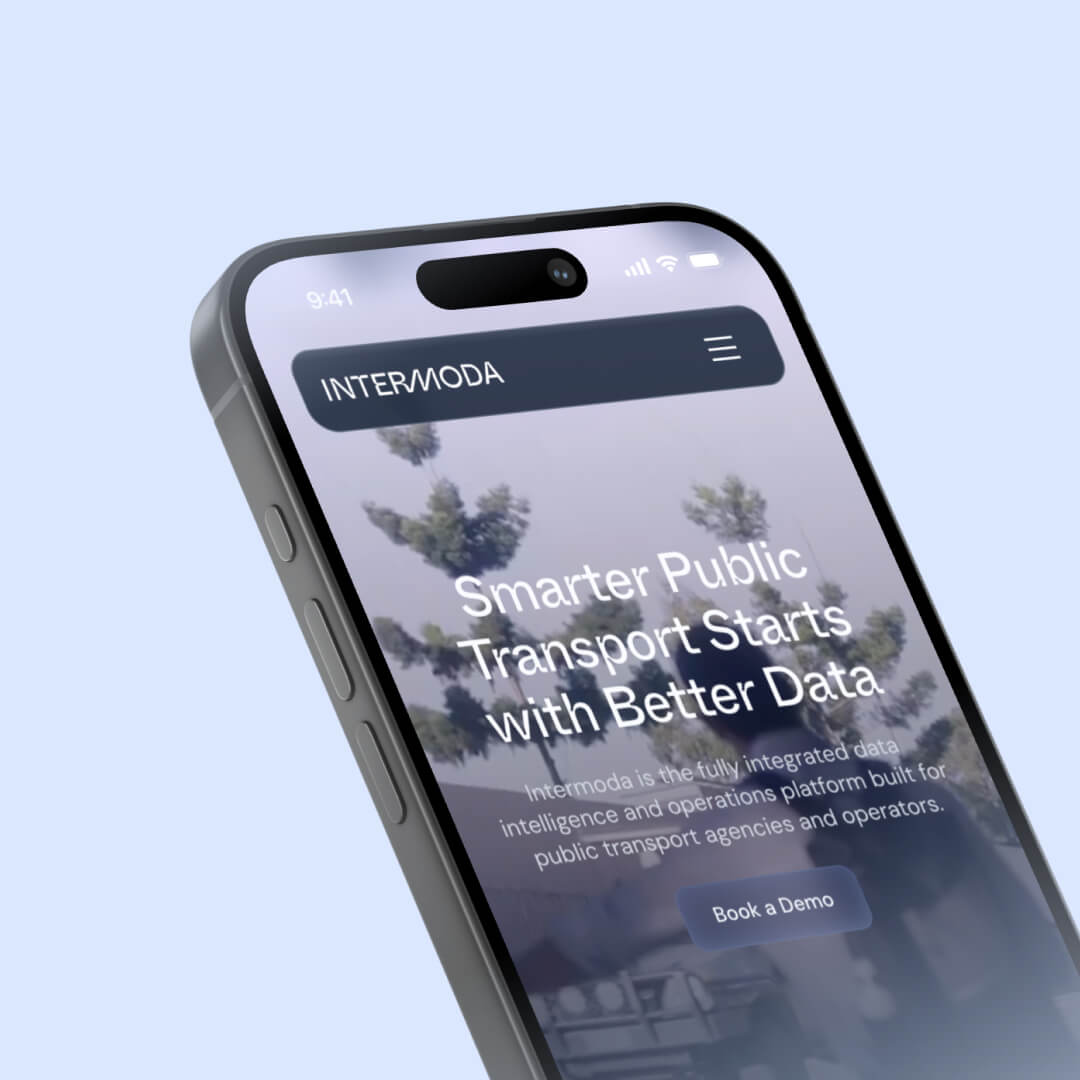
Intermoda was born in 2025 from the amalgamation of netBI and BRIDJ, a new name in transport data. It's a data intelligence platform built for public transport, covering bus, rail, tram and ferry networks across Australia, New Zealand, Singapore and the United Kingdom, with ambitions to reach even further beyond our shores. We developed the brand from the ground up, which meant the naming, strategy, visual identity, photography, video and the new website all sat with one team.
The name speaks to the multi-modal nature of public transport and the ambition to unify data across systems, teams and services. That idea didn't have to be explained to a second agency. It went straight into the identity, where the custom M leans forward to signal direction and progress, and into the brand line, 'Intelligence in Motion' which was subsequently trademarked. The homepage was written by the same team that came up with the name. So the launch poster and the homepage carry the same headline, "Smarter public transport starts with better data", and nobody had to translate a guidelines document to get there.
Every handover loses some of the reasoning
The more common path goes like this. The brand is done by a designer which gets handed off as a PDF of guidelines open to interpretation. A web developer starts from that, and the copywriter gets briefed weeks later. The homepage headline is written last, by whoever is left. Photography is shot to a different brief again, and the tagline that looked fine on a business card won't sit in a phone-width header.
None of those people are doing bad work. The trouble is what doesn't travel with the PDF. The designer who chose the typeface isn't in the room when the developer sets the line height. The strategist who wrote the positioning never hears the copywriter's first draft. You end up with a brand and a website that share a logo, and you can feel that they were made by people who never spoke.
What team collaboration looks like from the first workshop
On an integrated brand and website strategy, the strategist, designer, writer and developer are in the same conversation from day one. The designer knows why the name was chosen. The writer hears the positioning first-hand instead of reading a summary of it. The developer can say early that a line needs to work on a phone, before anyone has fallen in love with it.
That changes small decisions all the way through. A designer thinking about how the brand's distinctive assets show up in the grid while the strategist is still talking about it. A writer drafting the homepage who already knows what the CMS can support. By the time the photographer shoots, everyone has seen the layouts. Cross-channel design stops being a coordination exercise, because the identity was built knowing where it would live and the website was built knowing what the brand stands for.
It costs more up front, and some clients find that uncomfortable
You pay for strategy and naming before you see a single page. You also pay for the writer and the developer to sit in early workshops when they won't produce anything for weeks. On a quote, that looks like overhead, and we understand why people push back on it.
Splitting the work across suppliers can look cheaper. Brand agency first, web agency later, a copywriter on a day rate. The cost turns up later, in a homepage rewritten because the tone doesn't match the identity, or a layout reworked because the tagline is too long for the header. Often you pay for parts of the job twice and the seams still show.
So integrated marketing is slower and dearer at the start. We'd still recommend it whenever the brand and the site are both on the table, because on launch day the website already speaks the brand's language and nobody has to retrofit it.
Wolves don't stop mid-chase to brief each other. The plan was settled before anyone started running.