Your brand got you to where you are today. But if the business has grown or your offer has changed while the brand stayed put, you've got a mismatch. It usually shows up as divisions doing their own thing, or a positioning that no longer fits what you actually do.
Brand evolution closes that gap. The job is to make sure the brand can carry the business you've become and the one you're building towards. Leave the gap long enough and a brand that stopped evolving becomes someone else's lunch.
Evolution isn't the same as a cosmetic refresh
There's a difference between evolving a brand and giving it a facelift. A cosmetic refresh works on the surface: it might modernise the logo and tidy up the typography and colour palette. That can be useful if your positioning is sound and your brand is performing well. But if the fundamentals are weak, new visuals won't fix the problem. They'll just make it look nicer while it continues to underperform.
A refresh changes how the brand looks. Evolution changes what the brand can carry.
Brand evolution is strategic. It starts with a hard look at where you are, what's changed in your market, and whether your positioning still holds up. It might mean sharpening your point of difference or repositioning to reflect new capabilities. The identity work follows from that. It expresses the change rather than masking the problem.
Transit Systems evolved what was already working
Sometimes the pressure to evolve comes from success. The brand that got you here might not be the one that takes you forward, and that's a consequence of growth rather than a sign something went wrong.
Transit Systems is a good example. The company is a public transport operator with contracts across several Australian states and sister businesses in the UK and Singapore. By 2016 it had gone through years of expansion, and with each new contract win it had introduced a new localised business name and logo. That success was producing a disjointed parent identity, so they brought us in.
Workshops and consultation with each business unit made it clear that the localised branding was seen as a distinct advantage against the comparatively multinational brands of their competitors. So rather than consolidating everything under one Transit Systems roof, we unified the brand identity system so they could scale with consistency while keeping enough flexibility for that local touch. We liken refreshing an existing brand to steering a big ship, or in this case, a bus. You keep what's working and adjust course so it keeps working as the business grows.
We injected new life into the existing logo, fixing legibility issues and inconsistencies, and created a logo system that let local operations keep their own name and colourway. Since then we've delivered key marketing collateral, many ads and more recently a new corporate website built on Webflow. Most of the work in evolving a brand is deciding what to keep. Transit Systems kept the local identity advantage and gained the system to scale it.
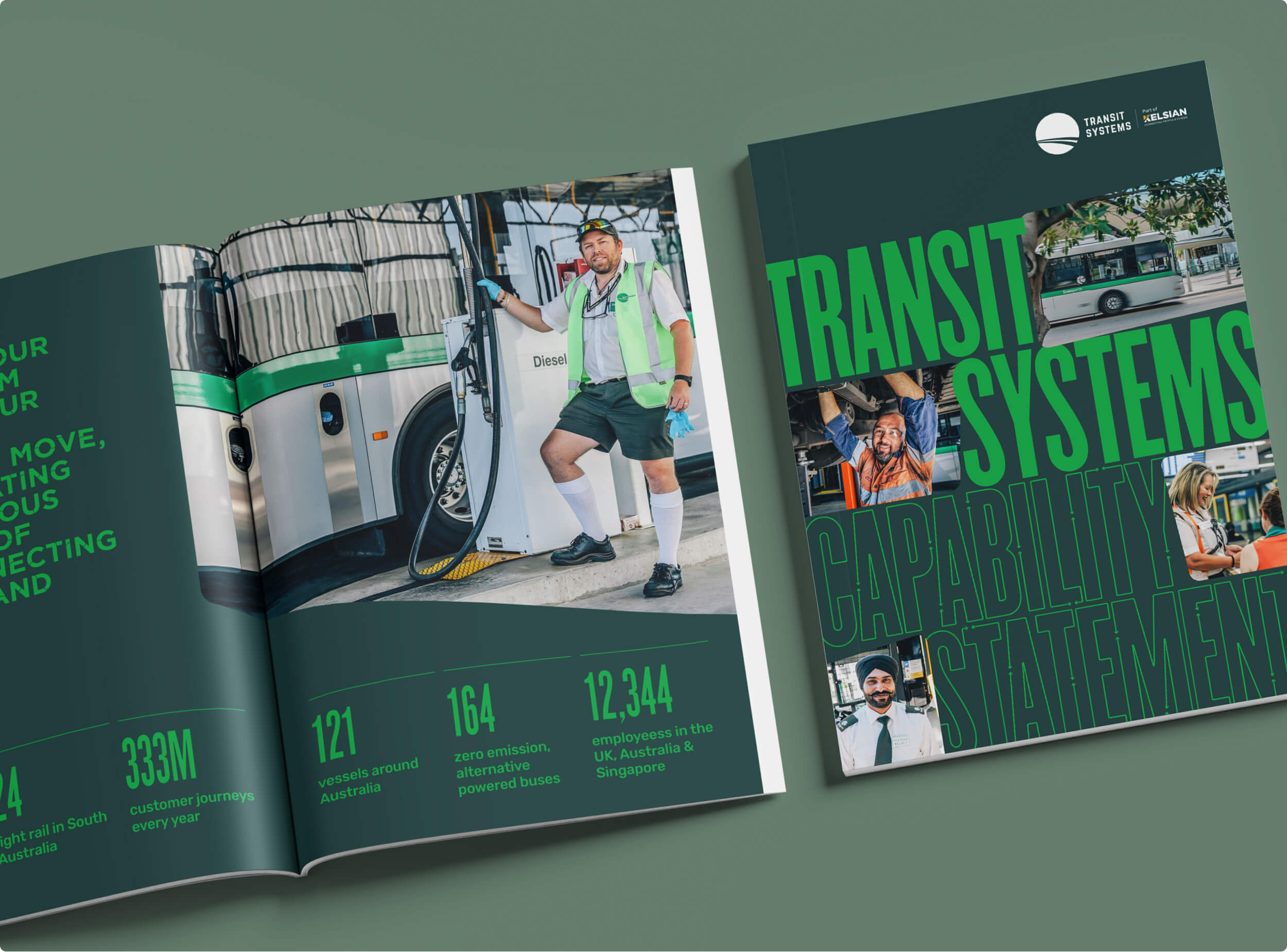
View the Transit Systems case study
Market disruption and the value of flex
Growth isn't the only trigger. Sometimes the market shifts and your brand needs to respond: a competitor repositions, or customer expectations move. We can't predict market disruption, but a brand system that can flex is easier to adjust when it arrives.
Is your brand ready to evolve?
Before you commission any brand work, run through these checks:
- Has the business outgrown the way the brand describes it?
- Are new divisions, products or locations inventing their own versions of the brand?
- Which parts of the brand do customers and staff actually recognise and value?
- Can the identity stretch to the next market or service without a new logo each time?
- Is the thing that makes you different still true, and do customers still care about it?
If you can't answer those with confidence, the work you need is strategic. Settle the positioning first and let the identity follow, because a system built on a clear position is far easier to stretch.
Evolve while the brand is still working
You don't need to wait for a crisis. The easiest time to evolve a brand is while it's still working, when you have the room to decide what to keep.
If you'd like an experienced opinion, talk to Creature.